Showing posts with label exchange student. Show all posts

A Korean Mouthful (Part 3)

There was something missing in Seoul that I couldn't quite put a finger on; a feature that marked the difference between western cities and their Asian counterparts perhaps even more than the exotic smells, unpronounceable foods and labyrinthine markets. I didn't notice its absence until I finally saw what it was: begging. We saw him in Busan. He was on a landing in the stairwell leading into the  subway station in Seomyeon. A cigar box lay in front of him containing a few thousand won: loose coins and crumpled notes. Bent forward over his knees on a small piece of cardboard, the man maintained a motionless half-tortoise pose, the world's ultimate submissive.  He draped a ragged blue jacket over his head and perfected an anonymity that was impossible to ignore. He was there in the morning and again in the night. For three straight days we saw him. In the same place, holding the same position. Never did he speak, never did he move. We knew nothing of his appearance other than he clearly had the hands of a man who had seen hard times. The South Korean society had imparted a burden of shame on this man heavy enough to crush. As a westerner, witnessing such a pathetic sight for the first time, I was conflicted. I found myself simultaneously hating this land that would force someone into such a state of surrender, yet also wishing the beggars and panhandlers at home in the United States would consider adopting his passive technique. I threw some coins into the box each time we passed him, South Korea's loneliest man.

The drive to Busan took nearly three hours, due in part to a lengthy pause for breakfast at a highway rest stop that would have been right at home on the Garden State Parkway. Mr. Jang led us to the lone traditional-style eatery on the otherwise vacant second floor of the complex, but the body language of our delegation was as vivid as the most brightly-lit neon signage: We wanted to finally eat real breakfast food. To his credit, Mr. Jang didn't force the issue, especially when a row of short-order cooks were downstairs assembling their own unique takes on ham-and-egg breakfast sandwiches, and pizza-flavored corn dogs (that contained neither cheese, sauce, nor a hot dog). Mr. Jang was a very likable fellow who I'm sure is very good at his day job, guiding Koreans on trips to Europe and China, but in this assignment he was set up to fail. He had never before led a tour in his own country, nor was his command of English up to the rigors of guiding people from the United States. He hopes to never do either again and I can't blame him one bit.

In continuing our gastronomical tour of the country, the itinerary called for just a brief one-hour stop in Busan for lunch. Though driving to a city hours away to do no more than have lunch is precisely the kind of decision that makes me long for independent travel, Mr. Jang couldn't have picked a better spot to eat, especially since the generous Mayor Hwang was still picking up the tab back in Gangjin. We pulled up to the Westin Chosun on Haeundae Beach, Busan's premiere western-style hotel, and were escorted to a window-side table overlooking the surf. It was the most splendid buffet I've ever seen with mouth-watering food from four continents and an endless selection of deserts and espresso drinks. Plate after plate of delicious food was put away into a stomach that was guaranteed to ache. Searching for a restroom, I felt my center of gravity being pulled to the right, as if the building was going to slide into the ocean. I thought it may have been something I ate. Turns out it was just the autographed photos of former President George W. Bush and Secretary of State Condoleeza Rice in a display case; a disruption in the Force if you will. The case also contained photos of the Duke of York, Crown Prince of Norway, President of Azerbaijan, and Prime Minister of Iraq, among others. It wasn't empty guidebook-praise, this was the place to stay in Busan. 

Though the tour bus would be departing immediately after lunch for the UNESCO-cherished historical sites in Gyeongju, some 90 minutes north of Busan, Kristin and I would be staying behind. Though I felt like a deserter, abandoning the group in such a manner, the initial tour was planned to last just three nights and I already had reservations in Busan. It was only by coincidence that Mr. Jang was leading the group to Busan the day we were planning to take a bus there. And when that coincidence happened to include a five-star buffet lunch, all the better. We really enjoyed spending those few days with Mayor Matt, Tina, and Andrea and Bob and are glad for getting to know each of them better. We were also happy to be back on our own, free of a schedule, and able to enjoy one of our favorite hobbies: wandering aimlessly in foreign cities.

Busan, South Korea's second largest city, is home to some 4 million people and sits on the jagged coastline in the southeastern corner of the country. Though the aforementioned Haeundae Beach attracts nearly a half-million visitors each day in the summer, Busan is very much a hard-nosed port city with precious little to offer visitors seeking a cultural or artistic sojourn. It's subway system pales in comparison to Seoul's -- due in part to the irregular coastline -- despite the seaside city occupying a larger footprint than the landlocked capital. As a result, the visitor looking to explore the city has to rely more heavily on taxis and buses than perhaps expected.

Our first order of business after waving goodbye to the tour bus was to buy a suitcase. Kristin and I packed light for the trip and though we had room in our bags for one or two mementos, our three days in Gangjin left us inundated with expensive Celadon pottery and other gifts. We didn't dare lug several hundred dollars worth of tea sets, bowls, and statues into the metro system in loose shopping bags so Kristin staked out a corner of the Westin Chosun's lobby and watched over our embarrassingly large pile of bags while I made my way to a nearby department store to buy a cheap suitcase. Suffice to say, when we finally did show up at the Zen Backpacker's Hostel later that afternoon, we didn't exactly fit the mold of the typical hosteler. Then again, Zen barely fit the definition of a hostel either. 

Occupying a four-bedroom condo on the fifteenth floor of the Neospot high-rise in Seomyeon, Zen was the opposite of what you'd expect from a hostel. Run by a thirty-something Korean named June, Zen is an excellent place to call home in Busan. June found a way to live the easy life in purchasing the condo and living off the fees of his visitors (he appears to spend his days hanging out, watching pirated movies, and, I suspect, getting stoned). Immaculately kept and decorated with trendy furniture and posters of Bob Marley and Jimi Hendrix, Zen boasts hardwood floors, a spacious kitchen, a high-definition television, and a Playstation 3 and computer terminal. It also has a lengthy balcony with views of the northern reaches of the city. Kristin and I reserved the private twin room for 60,000 won per night ($48 US). Two couples from San Francisco were in the quad across the hall and the six-person dormitory on the other side of the condo was currently occupied by a young Canadian fresh out of college and a soft-spoken guy named Misha who, at 38 years old, had returned to his birth-country from Switzerland in search of his true parents.

Unlike our first Saturday in Seoul a week earlier, we were both wide awake and looking to go out and party that first night in Busan. We hopped onto the subway and rode it 16 stops back to Haeundae Beach late in the afternoon. We walked two kilometers along the boardwalk then bar-hopped our way back in the other direction. It's a nice wide, sandy beach and was not unlike your typical beach town in the United States. Lots of bars, dozens of cheap eateries, and plenty of shops selling everything from giant plastic sunglasses to beach balls to umbrellas. The one thing it had that we certainly could have done without was the horde of Australian spring breakers. In a startling realization and admittance that I am actually older than I feel, I must confess to having reached the age where spring breaking college students is a demographic I hope to never encounter again.

We spent several hours in an unnamed and otherwise empty nightclub two blocks off the beach, shooting pool and drinking bottle after bottle of Cass, a Korean beer. It was a nice place with a massive oval bar, numerous couples booths, and a roped-off VIP area yet it was barely nine o'clock and we were assured that the place was busiest from midnight till dawn. The bartender, Haeyo, was a twenty-something Korean with an androgynous appearance and way about him that reminded me of the Japanese talk show host in the movie Lost in Translation. He was friendly, let us play whatever music we wanted, and even poured me a complimentary glass of Scotch after hearing me comment to Kristin about the Glenmorangie poster on the wall. We were initially going to only stay for a sympathy beer (I hate to enter a place then turn 180 and leave), but wound up spending most of the night there, the only customers in the club, shooting pool and enjoying our run of the place. When we finally did leave, it wasn't without a stutter in our step.

Walking back in the direction of the beach, we suddenly found ourselves hidden behind a wall of concealing hedges placed conspicuously between the street and sidewalk. Before we could wonder why this towering hedgerow was where it was, we had our answer: to our right was a half-dozen dimly-lit abandoned storefronts showcasing a number of scantily-clad Korean beauties. Though prostitution was outlawed in South Korea in 2004, we stumbled onto one of Busan's remaining red-light districts, albeit without any of the attention-grabbing red lights.  Dressed in lingerie and high heels, these women of the night stood not unlike mannequins in the windows of dilapidated buildings presenting their goods to anyone and everyone who walked by. Whether it was because I had my lovely bride by my side or because we were westerners, few of these women so much as acknowledged our presence. Though one or two smiled, nearly all of them looked past us with thousand-mile stares as if we were invisible. The very last one we passed said hello.

She was alone in a doorway, behind a partially-cracked screen door. She wore a yellow chiffon and lace teddy over a light blue thong with matching blue heels and was no more than 25 years old and no heavier than 100 pounds. She was cute, with petite curves, but certainly not gorgeous. To Kristin's amusement, I returned her annyong haseyo, smiled, then pointed to the girl, then Kristin, then back to myself and said, "Kugo olma eemneekka?" The girl laughed and smiled at Kristin who wanted to know what I said. "I asked her how much for a threesome." Kristin knew my query wasn't genuine, that this was simply another case in which my blend of curiosity and lack of taboos was getting the better of me. She shot me a look that told me she'd play along, but to not push my luck. The girl rattled off a fee in Korean that I couldn't understand so I grabbed a business card and pen from my bag and had her right it down. She was laughing, shaking her head in disbelief that she was having this discussion with a western couple, and wrote down 250,000 won, roughly $200 US. Not a bad price, I suppose. She then grabbed my left hand and pointed to the minute-hand on my watch and traced a full circle. One hour. Kristin nudged me in the ribs, as if to remind me that I was approaching the end of my rope, so I quickly thumbed the phrase book and told her the price was too high, to which she simply shrugged her shoulders and smiled. Enjoying the give-and-take, I countered by writing 200,000 won on the notecard and, in unison, both the girl and Kristin emphatically shook their heads no while seeming to fight back giggles. So I smiled and shrugged my shoulders in return and ended the negotiations with a friendly "Hengoonul peemneeda." I wished her good luck and continued our walk towards the beach, allowing the fantasy to play out in my mind while Kristin gave lighthearted jabs to my ribs and playfully reprimanded me.

We were out the door early the next morning, thankfully free of any hangovers, and had a quick breakfast at an overpriced French-style bakery before journeying north to Gyeongju. Two hours worth of subways and buses later, we arrived in this city of national treasures. It was a beautiful day out, sunny and near 80-degrees Fahrenheit, so we were happy to find a bike and scooter rental stall right near the bus station in Gyeongju. We settled on a tandem mountain bike that was both too heavy for its size and too small for mine, yet it worked. The attendant took no information down, no credit-card deposit, never asked for our passports, nor asked us when we'd return it. He gave us a lock and key when I asked for one, took our 15,000 won, and handed us the bike. Just as we started to pedal away I noticed that he had thrown a leg over a scooter and was riding off in the opposite direction, ignoring the crowd of would-be renters still milling around the bikes. Was that actually his rental shop? Did we just hand our money to a thief? Honestly, I didn't care. I welcomed the thought of having rented the bike from an impostor; I previously wondered what we'd do if the bike got a flat tire, but this latest development meant we could just lock it up and leave it. Nobody knew we had it and I was convinced we unwillingly rented it illegally.

The bike, awkward though it was, never did get a flat and despite having had no prior experience riding tandem, we managed quite well with me as the pilot and Kristin the stoker. Though many of Gyeongju's finer sites are located on the outskirts of town, nearer the coast and in the mountains, there are a handful of sites situated in the otherwise ugly downtown area that were within biking distance. We gawked at the massive earthen burial mounds in Tumuli Park (some measuring over 150 feet in diameter and nearly 40 feet tall), followed the well-worn path around Anapji Pond, and wandered amongst tens of acres of rapeseed flowers in Wolseong Park. Our days in Jeollanam-do had left us more burned out on cultural attractions than we had thought so we spent much of our time in Gyeongju simply riding the bike around town and window-shopping. Little did we know how sunburned we were getting.

We stayed closer to the hostel that night to make up for the bar tab we rang up in Haeundae Beach. The Seomyeon area of Busan has a number of neon-ensconced alleys lined with shops, restaurants, and bars as well as dozens of pojangmacha. We settled on a place that offered up a massive bowl of pork and kimchi noodle soup, big enough for two, that was as spicy as it was cheap. As was typical of the places we ate, we were again the only non-Koreans in the restaurant, but we felt right at home with all of the other twenty-something and thirty-something couples, sharing our bowl of soup, and wiping the spice-induced sweat from our brows. We bought a couple of bottles of soju at a convenience store after dinner and went back to the hostel to watch a movie with Misha. For the first time in my life, I browsed the illegal file-sharing networks and downloaded a pirated movie. The hoops one needs to jump to accomplish this task hardly make it worth the effort and I doubt I'd ever bother again.

Monday would be our last full day in South Korea and Kristin and I had a number of options on the docket, ranging from a hike to Beomeosa Temple on Geomjeungsan Mountain to a harbor cruise to a stroll around the coastal path on the Yeongdo Peninsula. Unfortunately, heavy rains forced us to abandon these plans and consider something indoors. We had given thought to going to the Hurshimchung public bath and hot spring for a soak and a scrub, but the sunburn we picked up in Gyeongju made that idea sound no more appealing than trudging up a muddy trail to yet another temple we weren't really that interested in. So we grabbed our books and headed to the luxurious downstairs food court at the awe-inspiring Lotte department store and sat and relaxed at a cafe nestled amongst the shops selling thousand-dollar canisters of tea and hundred-year old bottles of wine. There was even a Whole Foods grocery store in this fanciful basement selling, of all things, the putrid-smelling durian. Frozen, thankfully.

Though LG, Samsung, and Kia are the nation's brands most easily identified outside South Korea, Lotte is the giant within. Arguably responsible for fueling what I sensed to be a rapid rise in the ranks of the most shallow and fashion-conscious countries on earth, Lotte has brought the so-called good life (aka, the western fascination for designer brands) to Korea. Unlike the Japanese whose appreciation for western-style clothing seems to be kept in check by their own honored sense of isolationism and culture, Koreans appeared to be diving head-first, wallets-open into the maw of global westernization. The government's emphasis on learning English has given rise to what I saw was a misguided fascination with everything and anything English, to the point of absurdity. Western was it. To wear an American brand was a status symbol. To wear anything with English print was close enough. And so they did. The most attractive people we saw in South Korea were walking billboards advertising nonsensical gibberish; just a string of pronouns, adjectives, and verbs strung together on a t-shirt. To Koreans, they looked western and hip. To westerners like us they looked like fools.

The Lotte department store in Busan contained a collection of boutiques that would not fail to impress even the most upturned of noses from Rodeo Drive to 5th Avenue, New York City. But more startling than seeing such obscene sums of money spent in a place whose sewage system couldn't even handle toilet paper (used paper had to be discarded in a foul-smelling waste basket) was that which was on display in the eateries. You couldn't go a minute without seeing someone primping in a large handheld mirror of at least six inches in diameter. Maybe it was my seven years living in down-to-Earth western Washington, but the vanity on display in Busan  was frightening. To be seen or not to be seen, that is the question.

In truth, Kristin and I wanted to both spend the day on the couch back at Zen with our books and a large mug of coffee. We wanted to spend the day doing nothing except perhaps some laundry. And on future, longer trips we will certainly look forward to rainy days such as this one in Busan to do just that. But on a trip as short as this one was, just 11 days, we felt compelled to at least get out and do something, rain be damned. So we took the subway to Jagalchi Fish Market, Asia's largest seafood market, and promptly walked in the opposite direction to see a movie in PIFF Square. We were burned out on markets too, you see. We bought cheap disposable umbrellas from a stand in the subway station and splashed our way around this attractive pedestrian center before going to see Duplicity starring Julia Roberts, complete with Korean subtitles. Not a bad film.

We whiled away the time that final night in Busan at a German-themed brewhouse in Seomyeon imbibing a two-liter growler of their in-house Hefeweizen. We sat for over two hours waiting for the rain to let up, reminiscing about the trip that was, the places we had seen, the people we met, and all we learned. In volunteering to host Hyeon Ju we thought it would give us a chance to travel without leaving the home. We never imagined it would lead to so much more. Thanks to Mayor Hwang's generosity and the Snoqualmie Sister Cities Association, we were blessed to gain some excellent memories, a deeper understanding of a faraway culture, and best of all, a larger family.

Staring out the window of the KTX bullet-train bound for Seoul, my mind drifted back to the dragons at the Buddhist temple we saw in Gangjin. We entered the country with mouths and minds open and were going home with our teeth clenched on an orb filled with knowledge, food, and friendship. The world is a big place, filled with pleasant surprises in unexpected corners. South Korea is one of them.

A Korean Mouthful (Part 2)

As we passed through the elaborate wooden entrance gate to Borim Temple in Jangheung, our guide explained the two dragon statues we saw overhead. Both menacing in their gaze in hopes of scaring off evil spirits, the one with an open mouth symbolized the entering worshipper's need to be empty of distraction and receptive of knowledge. The other, with a large orb clamped between its sharpened teeth, represented the wisdom one would hopefully leave with as they made their way back home. "Maybe each of you will leave with a mouthful of knowledge too," she said. That was terribly unlikely, given that Mr. Jang only allotted a brief fifteen minutes in this Buddhist sanctuary. Nevertheless, I couldn't help but relate the symbolism in those dragon statues to the greater exchange student experience. We opened our minds as well as our home in volunteering to host Kim Hyeon-Ju, but it wasn't until coming here, to her country, and staying a night in her home, with her wonderful family, that we finally gained our own morsel of understanding.  And I was hungry for more...

Our scheduled meeting with the rest of our delegation at Gimpo Airport for a 7pm flight to Gwangju, in the southern Jeollanam-do province, didn't go as scheduled. The plans were muddled at best and suffered from several last-minute changes that left me in a foul mood before we even arrived. It was nearly 7pm when a Korean man with a sign bearing our names walked up in jeans and a khaki sport jacket. He was in his thirties, with a broad smile, and though Mr. Jang would be our guide for the next few days things didn't get off to a good start. Our mayor's flight was delayed and we could no longer fly to Gwangju. We had to drive with him back to Incheon to meet the other host family and wait for the mayor to arrive. We'd then pile into a private tour bus for the nearly 6-hour drive to Gangjin. If we were lucky, we'd arrive in Gangjin by two o'clock in the morning. I wanted to grab my bag and sprint back down the stairs to the subway and disappear into the night. I wanted to put into words just how asinine I thought this plan was. I wanted to tell him to bugger off and that we'd take a train down in the morning. But I couldn't. I was a guest in their country at the invitation of Gangjin's mayor, the affable Hwang Ju-Hong, and non-compliance would be the height of rudeness. Also, I had little to complain about. The other host family on the trip, Angela and Bob, had gotten to Incheon at 2pm from Shanghai, where they were visiting family, and have been held captive by Mr. Jang for the better part of the day. Then there was Mayor Matt and Tina, a board member of the Sister Cities Association, who would be stepping off a trans-Pacific flight and stepping right onto the unfortunate 6-hour bus ride. In comparison, Kristin and I had it pretty easy.

We woke in the morning with a stiff neck from the bus ride and a sore back from a bed that was little more than a boxspring wrapped in a sheet, but the annoyance of the previous night vanished as I pulled back the curtain. It's a strange feeling to go to sleep without any concept of your surroundings and I was too tired when we finally arrived (to a smiling Mayor Hwang and his staff armed with massive fruit baskets and bouquets) to look around or ask any questions. But after my eyes adjusted to the sunlight flooding the room, I saw that our room overlooked a grassy field with tasteful statuary and that we were nestled between a low-lying range of mountains to the west and a misty bay to the east. Between the statues and mountains lay numerous fields of leafy greens and rice. We were staying at the Dasan Center, a newly-built YMCA of sorts complete with hotel-like lodging for out of town guests. The bed made me long for a futon on the floor, but I very much appreciated the surroundings. It was great to be out of the city.

Gangjin, located on Doam Bay at the southern edge of the peninsula, is a town with a heavy reliance on agriculture and feels every bit the lengthy bus ride from Seoul. Gangjin has suffered a massive population exodus over the past few decades with numbers dropping from roughly 100,000 in the 1980's to just 40,000 today and Mayor Hwang is working diligently, along with the mayors of neighboring towns, to reverse this trend by reshaping these towns in a new light. The problems of Gangjin are universal to small towns and agricultural communities around the globe -- the young grow up, attend college, and move to the cities in pursuit of bigger paychecks and faster living. Gentrification sets in, the population drops off, and towns die. Part of the reason for our trip, or at least for our mayor being there, was that South Korea is very interested in the development practices on display in our little town of Snoqualmie. They have an official from Seoul living in our town for 18 months and Mayor Matt as we call him was asked to give a presentation on the "Live, Work, Play" design ethos at work in Snoqualmie Ridge, the community we live in. The presentation was to a crowd of 100 bureaucrats at work in city and county government and that if I didn't already live there, I'd be jealous of anyone who did. I'm sure many were. 

That first day in Gangjin was largely spent on official business with a few stops at local in-town historic sites mixed in. The Dasan Center we were staying at was named after a famous writer and thinker named Jeong Yak-Yong (Dasan was his pen-name) who was banished to Gangjin in the early 19th century for contrarian thoughts. Though he was largely known for authoring nearly 600 books, he also invented a number of devices such as the floating pontoon bridge and a crane for lifting heavy rocks. The people of Gangjin, his home-in-exile, consider him their own private Da Vinci. We'd later pile into a rustic room (crossed legs, shoes off) at Dasan Chodang, where he lived for 12 years upon arrival in Gangjin, and drink a milky rice wine called makkoli while a midday shower sprinkled down on the thatch roof. It was a relaxing break in the midst of a day filled with pomp, speeches, and more group photos than I care to admit. "Everybody say kimchi! One, two, kimchi!"

Following an exquisite lunch of grilled beef from regionally-produced shitake cattle (high quality beef is hard to find and very costly in this land of pork, seafood, and bulgogi), we moved to the county chief's offices for tea then back to City Hall for a lengthy exchanging of gifts with the city council and signing of an agreement that would further cement the ties between the two towns -- they'll be sending an official from Gangjin to Snoqualmie to study our culture and development practices for 6 months . I was asked to read the english version of the contract aloud which, I suppose, gives me the unique experience of having "had the floor" at a special meeting of a foreign nation's city council.

The highlight of our time not only in Gangjin, but of the whole trip, came later that night. Hyeon-Ju and her parents and brothers were waiting back at the Dasan Center to join us for a welcoming buffet that was arranged by the town. It was great to see her again and though her parents speak very little english, we were able to piece together enough to communicate well. Hyeon-Ju's mother (I am positively awful with names and must admit that I don't remember it) was much prettier than either Kristin or I expected. Though we didn't dare say so aloud, her mother had a similar impression of me and commented that I was much more fit than I had looked in the photo she had seen -- damn that wooly Scottish sweater! If this comment didn't make me feel at ease with her parents, then her father's first question certainly did. He asked us if Hyeon-Ju talked much with us in America or if she showed any emotion. He said Hyeon-Ju is a quiet girl who hides her feelings and that he was afraid we might perceive her reserved nature as a slight. Hyeon-Ju smiled and nodded along with her father's fragmented sentences as if she had read our minds and knew that we were a bit disappointed with the ease at which she said goodbye to us in February. It was upsetting to be the only host parents whose student wasn't crying their eyes out, but this set it right. We were unsure how welcome we'd be and suddenly had our answer.

We were two-thirds through our first plates of food at the buffet and starting to feel the effects of the day's near-constant feasting when Hyeon-Ju warned us not to eat too much, that her mom was planning a big dinner. Naturally, as a guest and especially when traveling, I always try to eat what's put in front of me and try a little bit of everything. I had even that next day eaten a very large piece of raw, fermented skate called hongeo hoe that tasted of pure ammonia (next time, I'll just urinate in a bowl and save the chef the hassle). I had never thought that being a gracious guest could lead to a dangerous metabolic situation, but I was fast approaching that point (and let's face it, the quality of the toilets in South Korea are something of a crapshoot... pun fully intended). Kristin and I simultaneously dropped our stainless steel chopsticks, intentionally this time, slippery that they are, and barely concealed our gasps. We each tried to muster an excited, flattered smile but on the inside we were pleading for a reprieve. The meal at Hyeon-Ju's would be our fifth of the day and these people weren't kidding around.

We quickly consolidated clothes into a single suitcase and piled into the Kim family minivan, a Kia Carnival, for the drive to their home on the edge of town. It's a modest three bedroom, one bath, single-story brick home at the end of a quiet lane surrounded by rice paddies. The living area consisted of three desks along the wall, a small table in the center, an exercise bicycle, and a state-of-the-art kimchi refrigerator by LG. The massive burgundy-colored chest was a technological marvel and clearly the wife's prized possession. Having a kimchi refrigerator may sound odd, but kimchi is eaten three times a day in Korea and an entire year's worth is made just once each winter -- satisfactory refrigeration is not an option, especially given its powerful odor. The other item in the living area, the one that really made us feel special, was a simple calendar hanging on the wall. The 15th of April, that day we were there with them in their home, was circled repeatedly. Someone had even drawn little stars next to it. It was the only day of the month that had any notation.


Hyeon-Ju and her parents must have sensed our sighs at the Dasan Center and understood how full we were because the big dinner never appeared. Fortunately, they instead laid out several bowls of snacks, and just a few banchan. I'm sure the massive spread put before us the following morning was the dinner they had planned for that night. So we nibbled politely at the snacks, drank a beer with her father, and tried our best to talk. Just when we were starting to really feel at home, they brought out the gifts. Hyeon-Ju's miniature 12 year old brother who spoke very good english (he's hell-bent on getting the grades to be an exchange student and says he only wants us as his host parents), and was forever running around the house doing curls with a pair of 3-pound dumbbells, brought us a box of cactus chocolate from Jejudo Island, an island off the coast of the Korean Peninsula that is the honeymoon capital of eastern Asia. Mom and dad went to Jejudo Island to celebrate their 20th anniversary the previous weekend and not only brought back the chocolate, but also a pair of dol hareubang carved out of a very porous basalt. They come in pairs and are considered to be gods that offer protection from demons and, hopefully to a lesser extent, increased fertility. They placed their half of the set in their garden outside and instructed us to take ours home and place it in our house; they will bond the families and protect us. "And now that you rubbed it, you'll have a baby boy," Hyeon-Ju's mom said as Kristin handled the idol. Hyeon-Ju must have told her parents that we don't wish to have any children because she was clearly teasing Kristin and laughing when she said this.

We brought gifts of our own, though unfortunately nothing as meaningful as the basalt idol. We had brought several one-pound bags of Hershey's miniatures, as big a hit in Korea as The Beatles in 60's America, for Hyeon-Ju and her two brothers and a bottle of wine from the Snoqualmie Winery for her parents. The mother disappeared as her father and I were opening our second bottle of Cafri, a very light-tasting beer that tasted surprisingly similar to Corona. We didn't see her leave, and she was only gone for about 30 minutes, but when she arrived back she had armloads of KFC fried chicken and sweet n' spicy boneless chicken wings. Trailing behind her were her two sisters, their husbands, and two of Hyeon-Ju's young cousins. And for the next two hours we sat and talked and drank and ate and got to know our new family, our extended Korean family. They sent their daughter to live with us, total strangers, and only by the generosity of their mayor did we get to meet, but the bond we felt with them was real. And as if to prove that it wasn't the Cafri playing tricks with our minds, the walk we took in the morning after the kids went to school, and the way Hyeon-Ju's mom held Kristin's hand and thanked us, made it all the more real. The language barrier was real, but you could read her eyes clearly. We returned her daughter home safe and sound, and took pretty damn good care of her while she was with us and gave her an opportunity no student in their town had previously had. We were family now.

Our delegation spent much of the next day feeling what it might be like to be rockstars. Gangjin doesn't see many westerners and when we walked through the halls of Gangjin and St. Joseph's high schools, the latter an all-girls Catholic school, we were greeted with a chorus of cheers and screaming and all-around hysteria. It was fantastic. High school in South Korea is the most important time in a child's life as their studies and placement tests dictate which university they can attend and, in some respects, what their future will hold. School runs from 7:30 am till 10:30 pm five days a week and for class again on every other Saturday. They wear uniforms, most students don't have hobbies, and few see each other socially. There is no time for that now, childhood all but ends at the start of high school for these kids. And knowing all this made it all the sweeter when the kids from a half-dozen classrooms threw up the windows and shouted down at us as we left. They waved and yelled and proclaimed their love, all the while their teachers tried fruitlessly to get them back to their seats. One young stud shouted down to Kristin an invitation to meet him in his dreams that night. I couldn't help but smile; at least he's got good taste. 

We'd see our students one final time before leaving Gangjin. Much to our surprise, all 12 exchange students were waiting in a receiving line for us back at the Dasan Center that night for dinner. The speeches and introductions seemed to drag on forever, but there was plenty of soju and a wealth of food and Kristin and I got to enjoy one final meal with Hyeon-Ju and some of the exchange students who just two months ago we'd never thought we'd see again. Conversation was funny and spirited and a couple of the boys we were sitting with couldn't believe that I had eaten the dreaded hongeo hoe earlier that day and began daring one another to eat it -- right up until one of them ran to the bathroom to vomit. Boys will be boys, all around the world. As fun as the night was, it had to end with a goodbye; this time for an indeterminate amount of time. I hate goodbyes.

We packed our bags and left the Dasan Center the next morning and drove to Jangheung, a vibrant city an hour east of Gangjin. Though I pride myself on seeing through high-gloss promotional videos with a cutting glare, I couldn't help but want to inquire about teaching english in this fascinating town shortly after the mayor's video ended. A small city keenly aware of what they have to offer and what they stand to lose if they don't hold onto their youth, Jangheung is a place I wish we had more time for. It's a place with festivals, parks, a sculpted pedestrian-friendly downtown, natural seaside beauty, and an up-and-coming tech sector, surrounded by farmland and a short drive from national parks. If only Mr. Jang wasn't cracking the whip and driving us onward towards Suncheon just two hours after arriving. But so is the case when dealing with tour guides; always at the mercy of the itinerary they create, a one-size-fits-none schedule assembled in a vacuum with higher importance placed on available bus parking than the traveler's interests.

The one benefit to leaving Jangheung and continuing our trip eastward along the southern coast of the peninsula was that we had finally run out of officials to glad-hand. We left the Jeollanam-do province and headed inland to a folk village that saved itself from being a complete tourist trap of Epcot-proportions by instituting a set of rules that allowed for workers to live in the village, provided they maintained a traditional way of life. Set on the sight of an ancient castle, with some of the fortress wall still in tact (and open for walks), I found the Suncheon Folk Village to be a rather dull locale, albeit with a couple of very photogenic villagers. Sadly, the most memorable aspect of the stop was watching Kristin eat a beondegi.

Our final night with the delegation (whom, if not for the schedule that was out of our hands was a really pleasant group to travel with) was spent at a wild tea house, a retreat of sorts located a mile down a dirt road from the thousand year old Seonamsa Temple. We hiked up to the temple in the late afternoon and wandered amongst the countless brightly-colored lanterns strung up in celebration of Buddha's upcoming birthday and listened to the chanting, drumming, and bell-tolling of the Buddhist monks. Despite their being an entire cottage-industry of restaurants and shops set up near the parking lot, the two mile hike to the temple provided ample buffer and ensured all visitors were adequately reverent by the time they arrived. With a night at the smartly-appointed, yet utterly traditional and simple tea house costing the equivalent of $8 US, I couldn't help but dream about retreating here to while away the days and weeks reading, writing, and making daily trips up the path to Seonamsa or to the far more remote temple 6 miles up a steep trail into the mountain.

I woke that next morning before sunrise and took a stroll in the chill air outside and gawked at the meadows of camellia in the distance, and studied the glow of the sun glancing off the sides of the tea house buildings. On a hill just above the retreat was a group of older Korean men doing their morning tai chi. Though my hands ached with a cold that only an early morning in the mountains can bring, I wrote page after page in my journal and promised myself that I would return to this place one day if I ever needed time to heal.

Prior to the trip, whenever Kristin and I mentioned that we were headed to South Korea, those who know us best commonly replied by saying that we'd be able to remove the country from the list of places to visit in the round-the-world trip we're planning. Truth is, visiting South Korea never occurred to us and wasn't on any list. And up until that moment, sitting alone in the sun, in the total calm of my surroundings, returning to this country didn't really interest us either. Sure, we had the same moments of weakness and passing fancy that people feel when they say they never want to leave that all-inclusive beachside resort they honeymooned in, but that was it.  Yet, there on that hillside, at that traditionally-styled tea hall with the ancient temple up the hill and the monks in their robes and a mountain of trails all around me, I realized I just might return.

When Kristin woke, I told her about my walk and told her that if something ever happened to her and I ended up alone, that this would be where I'd come. That I'd come here to write and to think, and to mourn. That I'd hike up the mountain and listen to the bells and the drums and follow the stream back down as my thoughts flowed out onto the paper. And though nobody on this planet would know where I was, she would know. And that if there really is a way to watch our loved ones from the afterlife, that she would know where to find me. 

And there wouldn't be a tour guide hurrying me onto a bus to Busan...

A Korean Mouthful (Part 1)

The bridge disappeared off to the right; a grand concrete and steel span crossing Kanghwa Bay and vanishing out of sight in a thick mustardy haze. Whether land was a mile out or five, I couldn’t tell. The air was impenetrable. Disturbing as the scene was, I couldn’t fault the people of South Korea for this unfortunate first impression as the suffocating blanket of smog rolled south out of China, rising on the onshore breeze like a tsunami of pollution. I was warned well in advance of the seasonal dust storms blowing out of China’s massive deserts, but this was no dust storm. There, on public bus #6011 from Incheon to Seoul, I began to wonder just how pointless my eco-efforts back home were as long as China continued to make 20th century industrial mistakes on a 21st century scale. I’d see only half of this bridge again, out the left-hand window eleven days later on my way back to Incheon International Airport, and though these wouldn’t be the only times my senses were so assaulted (Seoul’s sewage system is vastly outmatched by the population, as told by my nose), the vanishing half-bridge was a reminder of how this peninsula’s future will be just as influenced by its neighbors as was its war-torn past.

We arrived in Seoul four days ahead of the rest of our small-town delegation. Kristin and I were staying in a small hanok located in a traditional neighborhood known as Bukchon Village on the north side of this sprawling megalopolis. Once home to the city’s nobility during the fifteenth century, and nestled between the palaces of Gyeongbokgung and Chandeokgung just a few short blocks from Insadong, a popular pedestrian center home to numerous antique and tea shops as well as a few dozen street merchants hawking a number of snacks and kitsch, Bukchon Village was now the focus of historic preservation. Our hanok at the Seoul Guest House was devoid of furniture save for an unnecessary television cart and was a generous 90 square feet in size. It had no windows; we slept on a pair of thin futon pads stretched out over unplugged electric heating pads in a room in dire need of a breeze. We wanted traditional and paid for Spartan. It suited our needs perfectly.

Seoul is a city unlike any I've been to. It's routinely ranked in the top 5 most populated in the world with estimates placing the population between 10 million (city core) and 20 million (greater metropolitan area). One need only stare at a map of Seoul's ten subway lines and nearly 300 stations to realize the scope of this capital city. Partially ringed by mountains and bisected by the Han River, there is the feeling of some natural splendor amidst the concrete, but not much. Seoul is a utilitarian city, designed not to impress through inspired design and architecture, but to move large volumes of people from drab high rise lookalike apartments to work and back again. Space is not at the premium it is in Japan, as evidenced by the lack of the island nation's famed micro-cars and the overwhelming presence of American-sized Hyundai Santa Fes, yet you do feel that few people in Seoul have much personal space. We certainly didn't.

We woke our first morning in Seoul, Easter Sunday no less, at the uncivilized hour of five o'clock and found ourselves alone in the city under a blue and surprisingly smog-free sky. Nothing was open. We were starving and each of the convenience stores and coffee shops in Bukchon were closed. In this primarily Buddhist nation, our predicament had nothing to do with the holiday I once celebrated as a child, but because Seoul is a city that stays up late. Instead of opening, these stores had just closed a couple of hours before we woke up. I spotted a few shopping arcades on the map and led the way into a labyrinth of shuttered stalls and shops, hoping something would be open, that somebody would have some food. We called out random turns at each intersection and wandered deeper and deeper into what, judging by the drawings on the signs, was a maze of shops catering to electricians and machinists. None were open. No people were to be seen. I'm thankful the sun always rises in the east, else we might still be searching for a way out.

We wandered along the jogging path through the manmade canal, Cheonggye Stream, and practiced saying anyong haseyo (hello/good morning) to the smiling runners we passedWe spent much of that first day in Seoul searching for the most outrageously named counterfeit clothes we could find at  Namdaemun Market. The ten-buck Bulgari and Gucci watches merely whet our appetite for ogling fake goods; it wasn't until we spotted the fake outerwear that we realized what a treasure trove this place was. Kristin spotted a fake Pore-Tech jacket with a "The Black Face" logo (we'd later spot one with a "The Red Face" logo in Busan -- so wrong, but so funny) and my big find was a pair of sandals with an otherwise indistinguishable red, white, and blue "Fira" logo. Unable to help myself, I promptly did my best animated Kim Jong Il impersonation and sang a few bars of "I'm So Ronery." Ultimately, our favorite was a tribute to a timeless movie classic; a hat that simply stated "I Love Cake: Goodgies Never Say Die". Baby Ruth, anybody? The upscale Myeongdong shopping district, home to very legit boutiques carrying every American, Italian, and French luxury brand you can name was just a few short blocks away, but we were far more interested in the festival-like atmosphere at Namdaemun. Trying to stick to a budget of just 120,000 won per day ($100 US) as practice for our round-the-world trip, we lunched on chicken heart skewers and ddukboki (rice cakes in a spicy red-pepper sauce) at a pojangmacha with a small plastic table and stools. We'd come to realize that each of Seoul's markets specializes in its own local street food, all the more reason to carry plenty of spare change and resist the temptation to have a sit-down lunch in a restaurant.

Knowing that our time in South Korea would unfortunately take the form of a guided tour come Wednesday morning and that I would have to surrender all independence and be led unwillingly from one cultural site to the next as an honorary -- and very appreciative -- guest of local government, I set to immerse myself in real-world Seoul as much as I could in the short time we had. I struggle to think of a better way to accomplish this than heading to Jamsil Stadium for a game between the LG Twins and Doosan Bears, Seoul's two baseball teams. Watching the Korean teams on television during the Olympics and World Baseball Classic only tells half the story. While there's no denying the talent on the field isn't quite on par with your average Major League club (though they are very, very good), we American fans are downright bores compared to the Koreans. This wasn't a baseball game we attended; compared to an MLB stadium, this was like going to a Brazilian soccer match.

For starters, nearly everyone in the 30,000 person crowd had a pair of inflatable clapping sticks (including us) and at least half of that crowd could be heard banging them together every moment of the game. I sat mesmerized in the first inning as the fans of the Doosan Bears, sitting along the third base line, clapped in unison during every at-bat. Supporters of the LG Twins, the home team that night, tried to outdo them once the pitcher had gotten the count to two strikes. Each side had their own style and each had their own unique songs for nearly every batter that came to the plate. The noise was tremendous, thundering through the stadium into the night sky, and never let up. Nine nonstop innings of singing, banging, and stomping. The only time the synchronized banging of the clapping sticks yielded was during the sixth inning stretch when a couple of fans were invited onto a miniature stage for an impromptu karaoke contest. 

The choreographed use of the ubiquitous clapping sticks and singing was a far cry from the uninspired "Yankees Suck" chants that serve as the height of fan creativity at MLB games back home, but it wasn't the only difference. The game turned on a sixth inning fly ball to right-centerfield. The right fielder ran over and seemed to have the clearer play on the ball, but was waved off by the center fielder moving in. The center-fielder presumably lost the ball in the lights. It fell, untouched, eight feet in front of him. Nobody booed. The Doosan Bears took the lead on that play and never gave it back. The non-catch happened right in front of us and the other LG Twins supporters we sat amongst, yet nobody disrespected the player for his error. Everyone was disappointed, for sure, but I can only assume the fans knew he felt enough shame and there was no reason to pile on. The fans immediately went back to their singing and stomping as the pitcher struck out the next batter. We moved over to stand amongst the diehards near first base for the final two innings and were overwhelmed by the passion. It was only the third game of the season and it had all the electricity of a pennant race, multiplied (click here for video; forward to the 3:00 mark for where it really heats up).

Kristin and I fared much better in our search for breakfast the following morning, a Monday. We'd visit the same small cafe in Bukchon Village both of our remaining days in Seoul and sit for an hour or two, drinking our coffees, eating our spongy bagels with their vanilla-flavored butter,  and relaxing. Traveling can get pretty exhausting if you don't sit and do nothing every now and then; I learned this lesson fast. Kristin couldn't escape mandatory reading for business school and was nose-deep into books on leadership and the economy of China whenever not scribbling away in her journal. I was reading "Dark Star Safari" by Paul Theroux and simultaneously wondering if I would ever make the leap from writing strategy guides for videogames to writing about real places, like Theroux. Would I ever possess his mastery of the language? Could I ever be as perceptive? Would I ever dare attempt a trip like his? Or should I just go on trying to master my own niche and accept my lot? Traveling can get pretty depressing if left to sit with your thoughts for too long; I doubt I'll ever learn this lesson.

We sped through nearby Gyeongbokgung Palace, a grand royal residence torched by angry Koreans in 1592 after the frightened leadership fled the city for fear of Japanese invasion. It was rebuilt some 300 years later and is impressive for its size and for the brightly-colored paintings that adorn the ends of each and every roof beam. Too bad about the chicken wire being needed to protect it from pigeons. We wandered the myriad dirt paths that linked the dozen or so buildings; we gawked at the iron dragons perched on the corners of the hip-and-gable roof; and we climbed the stairs of the primary structure and stared out over the palace grounds to the gate and noticed no less than twenty tour buses offloading their cattle. We sprinted down the stairs, out the temple gate, and escaped to Anguk Station.

Three subway lines and 9 stops later we emerged on Yeouido Island, a massive island on the south side of the Han River and home to Seoul's financial district. Nearly every worldwide banking acronym from AIG to ING has their logo on the side of a towering building here, but that's not why we came. We came for the parks, or more specifically to see the cherry blossoms and to rent a bicycle. South Korea's President Lee Myung-Bak is working hard to get Koreans cycling and is actively pushing for cities like Seoul and Busan to build more bike paths. Two such paths run along either bank of the Han River and stretch for over 40 kilometers.

A young couple approached us as we were exiting the subway station at Yeouido to tell us the park is all torn up for construction and there's nothing to see. "Sorry to tell you this, but you came here for nothing." He was the first westerner we had seen since leaving the airport. He was pale, red-haired, and had a baseball cap on and what looked like lacrosse shorts. He seemed a bit overly friendly, and a little too eager to share this major discovery. He knew something we didn't and wanted us -- westerners that we are -- to know it. The female half of the couple, a cute Korean of about 25 years, quickly cycled through the photos on her camera to show me the destruction. It was true, the riverside park was one giant mound of dirt, laced with orange plasticized fencing, and sprinkled with heavy machinery. 

"What about the other parks," I asked "are they torn up too? We were really hoping to go walk around Yeouido Park and then rent a bike."

He didn't know there were other parks on the island. In fact, though he made reference to the Lonely Planet guidebook, he clearly never looked at the map it came with and focused too much on the recommended sites. The island has no less than four parks. Only the one along the river and nearest the subway was undergoing renovation. So we smiled, thanked him for the tip, and continued up the stairs. We hurried across an eighteen-lane intersection to Yeouido Park, where we whiled away a warm spring afternoon. We walked aimlessly along the paths watching children feed enormous strawberry-red carp in a pond; we sniffed at the cherry blossoms floating to the ground on a gentle breeze; and  we smiled at the sight of business men in fabulously tailored suits sitting on the grass licking ice cream cones. It was lunchtime in one of Asia's most important business centers and we were among thousands of Seoul's wealthiest in a beautiful park, all out for a midday walk. Some even making use of the exercise equipment, suit jackets and all. Not to be left out, women in skirts kicked off their heels and walked along the winding Zen-like stone path designed to stimulate the pressure points on your feet and toes. Kristin and I bought a couple of giant buckets of instant ramen at a lunch shack in the park and slurped our noodles alongside the well-heeled, both of us outrageously underdressed for present company.

Knowing it was our last night in Seoul, we thumbed the guidebook in attempt to find a restaurant that we could splurge a bit on without disappointment. We settled on a place that specialized in black pig -- they smoked it outside then it was grilled table-side. Plus they had soju, and we were certainly in the mood for a drink. Unfortunately, Lonely Planet's directions to Jongno Gol couldn't have been more wrong if the guidebook author had been dyslexic. Each of the exits in Seoul's massive metro stations are numbered and face a particular orientation on a specific side of the street. Get the number of that exit wrong and all of your further directions become useless. Now, as an imperfect guidebook author, albeit of videogames (I commonly describe what I do by saying I write travel guides for fictitious places), I can sympathize with the author and understand that mistakes can and do happen. That said, we were really, really looking forward to eating at this restaurant and he certainly didn't help our cause.

I sensed something was wrong with the directions almost immediately and decided to ignore them post-haste. We wandered around on the wrong side of a busy avenue (the crosswalks were underground) for a few minutes before journeying to the other side. I had a map of unnamed streets and a dot corresponding to the location of the restaurant. Addresses don't exist in any meaningful way in Korea, especially in Seoul. In many ways, this was just like using one of the maps I include in my own guidebooks, minus my expertly-crafted instructions on where said secret item is located. We wandered down a couple of alleys until finding one that zigged and zagged in agreement with the lines on the map. Yet where the map showed just one alley to the right, we found three. I led us down the first one, a narrow path barely wide enough for three people walking abreast. We passed some bars, a couple of sketchy restaurants, and a brothel posing as a barbershop. Not an english sign to be found anywhere. We reached the end of the alley and were just about to turn around when I smelled it: smoked pork. I breathed deeply and followed the scent down an alley running perpendicular. It was dark, we were between buildings in a back alley, and it certainly didn't look like any place tourists would venture. Yet that delicious scent intensified with each step and just a few short minutes later we were sitting on a floor cushion, legs crossed, shoes off, with a bottle of soju and a waitress placing a cauldron of red-hot coals in a grill in the center of our table.

I'd like to say the night ended with a drunken taxi ride back to the hanok where we made love and capped off a wonderful day overseas wrapped in one another's arms. And I can, after all it's my story, but that wasn't the case. Well it was, but not before breaking one of my cardinal rules: Don't pay for an elevator ride. Ever. I can't tell you how many visitors I've had to talk out of taking the lift up into the Space Needle in Seattle on account of it being a giant ripoff and there being better (and free!) views of the city to be had from a nearby park. You'd think I'd take my own advice, but no.

We left the restaurant and promptly hailed a cab for Namsan Mountain in the center of Seoul where we then paid 15,000 won for two tickets on a cable car that leads to the top of the mountain where the city's iconic N'Seoul Tower is located. Again, think Space Needle. The ushers packed about 50 of us into the cable car. Nobody could move; we couldn't even turn around. At the top we realized that the powers-at-be cunningly planted a number of trees so as to block the views of the skyline. If you wanted to see the city lights at night, you had to ride the elevator. Another 15,000 won for two, thank you very much. We hemmed and hawed and ultimately decided that we were eight time zones from home, dinner was cheaper than we expected, and what difference does twelve bucks make anyway? I'm embarrassed by how easy it is to convince me to do something when I'm traveling.

The windows on the observation deck were filthy on account of the periodic April dust storms and the constant pollution but even if they weren't, a ring of horrendously-placed fluorescent lights in the ceiling made it all but impossible to see much more than a glare and your own reflection. We walked the ring and noted the signs indicating that we were over 8,000 kilometers from Seattle and nearly 12,000 kilometers from our family in New Jersey. I tried to take some photos, but it was pointless. And it's not as if Seoul has a really distinguishable skyline anyway. If anything, we were inside the one noteworthy feature in the night's sky. I suppose I could have taken a photo of the floor.

The cable car was much emptier on the way back down the mountain. Once there, we brushed past the extortionists in the black "translation services available" taxi cabs and walked back down the hill towards Myeongdong and into the city until spotting one of the silver cabs. We had one more day in Seoul on our own and used it to explore Bukchon Village's nooks and crannies and to hike up to a Shamanist Shrine on Inwangsan Mountain, where we heard an otherworldly blend of instruments and chanting emanating from the closed doors of Guksadang shrine. We sat outside quietly and listened to the Korean Shamanists for several minutes, before continuing our hike up the mountain to Seoul's fortress wall. As suspected, the views (free!) from atop Inwangsan far surpassed any we could have hoped for from N'Seoul Tower. Lesson learned. Until next time...

*This is the first of what I expect to be a three-part story. Please submit any comments or questions either here on the blog or by emailing them directly to me via the link on the top-right corner of the page. I hope to have part 2 completed within a couple of days. Kamsahamnida.

Saying Goodbye

If I was to receive one of those Facebook memes that ask when the last time I cried was, I'd have to say that I indeed got a bit teary-eyed last Thursday night. At a Starbucks, of all places.

It was there where the twelve host families and our South Korean exchange students had gathered to bid one another goodbye, and as the ten minute farewell turned into a 40 minute so-long-forever, there was hardly a dry eye in the store. Hyeon Ju never got emotional. She's not that type of kid. She was the one going around telling the other kids everything was going to be okay, and that they shouldn't get upset. She hugged us goodbye and we took a final farewell photo, then she was gone. Darting back and forth from one forlorn kid to the next. She was the mother hen to a half-dozen heart-broken teenage girls. And, to be honest, her lack of emotion or tears actually made us feel a little sad. Why is she not crying like the other kids? We wondered briefly if she ultimately didn't really like us or if it's just not her nature to get emotional. Looking back on the 5 weeks she spent with us reveals a bit of the latter. She always seemed far more businesslike than the other kids. She would laugh and smile and man did she love playing Rock Band 2 every night with me, but she never expressed any sense of homesickness. Even at the parties we would attend, when all of the girls were in one room doing little teenage-girl gossipy things, she was in the other room, drumming some steady beats on Rock Band. She never acknowledged missing her family, her brothers, her dog. Never mentioned her father. She is a sweet girl who we really enjoyed sharing our home with, but she had her defenses up and, even if only on a subconscious level, probably knew that it was best to not get too attached.

Kristin and I wondered if because we didn't have kids made it easier for her to keep a distance between us. The families that had teenage kids were certainly much more emotional at the goodbye; their students were almost inconsolable and many all but refused to go. The teenage daughters of the families were clearly upset at losing a friend. It was very, very somber. Nobody likes saying goodbye, and the sadness in the room was suffocating.

On the other hand, Hyeon Ju was smiling. She was happy for the experience, happy to meet friends, and was very much looking forward to seeing Disney Land and the Grand Canyon, where they were headed before flying home to South Korea. She seemed to see these 5 weeks not as a display of a life she'll never get to lead, but as a simple experiment in travel. She made some good friends -- numerous Mt. Si High School students signed a tee-shirt she was given and included email addresses and very nice messages -- and took tons of photos, but rather than dwell on not ever playing Rock Band again or going home to parents who don't play games or to a place where the choices are fewer and the schoolwork never-ending, she seemed to enjoy it for what it was.

I mention the differences between her life in Gangjin and the life she saw here only because it was something Kristin and I tried hard to not flaunt while she was here. Some of it was unavoidable -- like my willingness to play Xbox with her or Kristin's desire to take her to the zoo and movies and just the sheer volume of choices of food in our pantry and at our grocers -- but we didn't want to go overboard regarding how great we have it here. And we really do have it great, her wide-eyed astonishment at things we consider trivial proved this. This isn't to say that she's going home to some horrible land and will be left wanting for what we showed her, but more that we all know how different things are there. For example, even though she attended school here every day and did plenty of Korean homework at night, this was a vacation. Back home they are in school from 8am till 10pm five days a week and every other Saturday. They have it harder there, as simple as that. Back home she has two brothers and parents who love her, but I get the impression she lives in a house without much laughter and with little play. It's just a difference in our societies and perhaps even just our two homes.

Some of the students were keenly aware of this and cried and sobbed and pleaded with their host families to let them stay. A few of the students took turns standing on a chair in the Starbucks and made passionate, heart-felt speeches about the great time they had here, the love they had for their host families, and their desire to return again. One boy swore he would return to Snoqualmie to visit as soon as he could and anyone who could see the look in his eyes and hear the quiver in his voice knew that this was not an empty promise.

My eyes swell with tears even now as I type this just remembering the emotion of the goodbyes on display all around the room. Five weeks, as it turns out, is a magical amount of time. The first two to three weeks allowed the students to get over the culture shock, the homesickness, and for them and their families to get to know one another. The final two weeks forged friendships, bonds, and a closeness you wouldn't anticipate during those first couple weeks. Hyeon Ju really seemed to enjoy herself those final two weeks. She'd watch television with us in the evening, she'd help clean up from dinner, she'd play Rock Band with me every night. Instead of retreating to her room after dinner every night like she did the first couple weeks, she actually stayed downstairs until well past eleven each night. She became a member of the family. Five weeks was just enough time to really start to feel attached. And then she had to go. They all did.

Kristin and I will be headed to Gangjin in April and, as it turns out, I'll be speaking to Hyeon Ju's class about America and what it's like to be an American. I hope to meet her family when we get there and to tell her parents what a wonderful daughter they have and to reinforce our invitation to her that anytime she ever wants to return to the United States she has a place to stay.

The house has gotten a bit quieter since she left. I no longer turn on the television and find it set to Cartoon Network. I can use the bathroom nearest my office again. It no longer smells like exotic shampoos and perfume. The dogs miss her. We have an abundance of left-over Korean food in the pantry, food she brought with her in case she hated American cuisine, but never ate. We just finished the last of the ice cream she picked out and tomorrow I'll eat the last of the chili we made together last weekend.

I hope she remembers us.

Random FEZ Notes

It's hard to believe our 5 weeks with Hyeon Ju will be coming to an end in just 9 days. It really flew by, partly because I spent a week on the other side of the world, but also because she's really been a joy to host. Her confidence with English, our house, our dogs, and food grows with each passing day. Here's a few of the more notable moments from the past week or two, and proof that, once comfortable, all teenagers are the same.

- The high school students were taking final exams last Wednesday so, rather than sit and be bored all day, the Korean exchange students went to Olympia for a tour of the state capital and got to sit on a legislature meeting. They then returned to the high school by 2:30 for a party the Key Club (Student Council) was throwing for them. I was told to pick HJ up at 3:30, but this was faulty information. Nevertheless, I arrived at 3:30, found my way to the party and... was promptly ignored. She smiled, said hi, then went back to talking to her Korean friends. Finally one of them looked at me and said, "She'll call you when the party is over." HJ gave me a look like, "Gosh, dad, leave me and my friends alone, you're embarrassing me!"

- We took HJ to the Chinese New Year feast we attend each year in Seattle's International District (yes, Seattle is too PC to simply call it "Chinatown" like everywhere else in the world) and, before leaving, I asked Kristin to have HJ change out of the windbreaker she was wearing all day. It wasn't cause to wear a dress or for me to wear a jacket & tie, but we thought it'd be nice if she at least put on the nice sweater she had with her. She told Kristin no. So Kristin tells me this and was prepared to let her do what she wanted. I was having none of that, so I went and talked to her. She seemed agitated, but she put the sweater on. Clearly, "don't make me tell your dad" is universal the world over.

- Kristin invited a couple of HJ's girlfriends over for our Super Bowl Party on Sunday, expecting their own respective host families to want them with them on the weekend. Oh, were we mistaken. All three showed up over an hour before kickoff and wouldn't leave until the game was over. They didn't watch the game. Not a second of it. Instead, they spent the first hour or so in the kitchen woofing down more food than you'd ever think four 80-pound girls could possibly consume. One of our friends brought over a couple dozen red velvet cupcakes and they weren't on the table for more than five minutes before HJ and her friends were going back for seconds. They sampled everything. Including one of each flavor of the Thomas Kemper sodas I had in the non-alcoholic cooler. Ginger Ale may as well have been the devil's piss judging by their reaction to it, but they promptly ran upstairs to Kristin's laptop and started emailing HJ's older brother back in South Korea about how great the soda was. She came downstairs and asked me if she could bring a bottle of "American Soda" home for her brother, "he really wants it".

- The girls spent the entire first half of the Super Bowl upstairs in HJ's room talking and doodling and surfing online Korean comic books and cartoons with Kristin's laptop. Kristin is afraid she'll never get her laptop to work in English again but, hey, at least the girl knew to leave my setup alone. They came back down at the start of the third quarter, as if summoned by a dinner bell, and promptly put a serious dent into the various salads and sausage & peppers that were available. I have no idea where they put this food.

- HJ was a bit too anxious to help us clean up after the party. Perhaps she had something on her mind? Perhaps she was trying to score points before asking a favor of me? Could it be? Why yes, that was exactly what she was doing. We were just about done cleaning up when she asked me if I can drive her and a friend to the outlet stores on Tuesday after school. I right away thought of my workload and having no time to spend at the outlet stores, so I asked what stores she wanted to go to. "No stores, just you drop us off and we call when we're done." I would have been annoyed at being reduced to a taxi service, if not for the fact that this worked out much better for me.

- Kristin took her to the aquarium on Saturday and (again) to the outlet stores where HJ bought Gap shirts for her siblings. The shirts are plain tee-shirts with a giant Gap logo on them. I imagine for a small town five hours south of Seoul, having some western branding splashed across your chest will indeed be a big time status booster for a teenager, but I couldn't imagine why anyone would ever wear these shirts -- who are these stores selling them to? Are they surviving on exchange students from the Far East to get by? Then I remembered how willingly the teenagers here seem to embrace being billboards as well. Gap may be a bit long in the tooth at this point, but the thought is still there. Probably why HJ passed on the much-nicer workout pants we offered to get her (for gym class) in favor of the ones with the big ol' Adidas logo.

That's all for now, more to come next week. I'm sure this Saturday's Rock Band party with all the students and host families will provide plenty of material...

The Stranger in our Midst

This is going to probably be a bit harder than we thought.

We picked up Hyeon Ju last night at 5:30 and it was clear within minutes that her command of spoken English is just north of minimal. In theory, Kristin and I were expecting to have a somewhat difficult time conversing with her, but weren't too concerned since we've both spent weeks in other countries where English wasn't common. We knew we'd have to speak slowly and use very basic words, and this definitely seems to help, but simple things such as expressing our wish for her to "make herself feel at home" was challenging. We'll get through it though, I'm sure, as she has a pocket electronic dictionary and I have a Korean phrasebook. I will say that she knows a lot more english than I ever knew of Spanish. Speaking of spanish, I was very proud of myself for not defaulting to, "hola" upon meeting her as I so often do when speaking to someone who I know is not a native English speaker. Yes, I even found myself telling the Hugarian waitresses in Budapest, "gracias" when they brought the food.

I'm an idiot, but I have good intentions.

But back to Hyeun Ju (whose name I will probably misspell a thousand times in this post)

She's reading a bilingual version of a recent Obama biography -- each page is both in Korean and English. That's a good start to getting on my good side.

Last night was a little stressful, no doubt moreso for her than us. Kristin about freaked her out upon our initial meeting when she went to give her a big, American-style, welcome hug. Um, yeah, I forgot to tell her not to do that. The girl was totally confused as to why this total stranger was throwing her arms around her. She braced herself and hugged back, but was definitely a bit weirded out by it.

Hyeon Ju immediately took a liking to our dogs, who followed her around nonstop in return. I think they're going to be excellent ambassadors and help entertain her. I already know Annana in particular is going to miss her when she leaves.


After sitting in a bus for 6 hours, then a plane for 10, I was expecting her to want to get right to bed, and for a while we thought she did. She didn't want dinner and made that clear, but did eventually come downstairs sit and have some water while we ate. She's a very nice young girl and showed us photos of her family on her camera. I offered to print them for her to hang up in her bedroom, but the camera she has doesn't have a memory card. Internal memory, perhaps? I didn't force the issue last night, but I'm hoping she has some sort of USB cord or something -- the plug input on the side of the camera wasn't anything that I've seen before.

After dinner I showed her a map of the world and showed her where we were, where Kristin and I grew up, and she quickly seized on the size of the USA and wondered why we would live so far from family. The idea of flying back and forth once or twice a year is completely, well, foreign, to her.

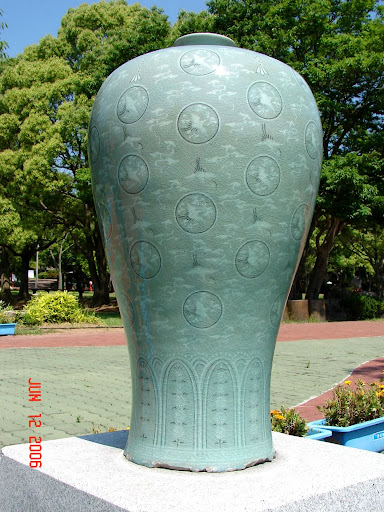
It turns out her town of Gangjin is located at the southern tip of the Korean peninsula. Every city is known for something, and hers is pottery. She brought us a fabulous vase that I discovered by chance, thanks to Google Image Search, is from the Goryeo Celadon kiln. The kiln is a major draw for their town and they have a very large version of the exact same vase her parents had given us. The version she brought us -- a very fragile carry-on, no doubt -- is about 16" tall.


In a move that was either totally due to exhaustion or an example of her being wise beyond her years, she went to bed at 9pm and slept until 10:00 this morning and seems just about free of any jet-lag. So far. She was supposed to have gone to school at 8am this morning, but the schools are closed due to the flooding so she got to sleep in. She's out touring with the other students and the South Korean delegation today, then we meet her back at the Salish Lodge tonight for dinner. The mayor of Gangjin has hired a Korean catering company from Seattle to prepare an authentic Korean dinner tonight. I can't wait.

Speaking of food, we're going to take her to Uwajimaya next week to pick up any snacks or specific foods she's used to from home and see if she would be up for cooking dinner for us. I asked her last night what she usually eats for breakfast and she said, "meat wrap".

She had a bowl of Rice Krispies this morning and seemed to enjoy them, but I'm thinking of making her some breakfast burritos next week.

There's not a whole lot to say so far, since she's only been here for 20 hours or so, but she's very interested in everything around her. She seized upon the medal I have from the Leadville 100 that hangs on my lamp in my office and that quickly lead to me showing her photos from the mountain bike trips I've done and her, in exchange, showing me the photos of her bicycle on her camera.

When I was showing her the map of the world I have and pointing to places we've been, I asked her where she wants to travel to. Her answer? Everywhere.

This is going to work out just fine.

Finally, this morning, in perhaps a sign that these next 5 weeks are going to undoubtedly force us to look at our own way of living a little different, she was completely awestruck at the garage door opener. I expected her surprise at us having two cars, but I didn't foresee the wonder on her face when I hit the garage door button.

That was pretty cool.

And pretty eye-opening for me too.

Avalanche and Floods: Rainpocalypse 2009!

From Yahoo:

Warmer temperatures and heavy rains were melting snow dumped on the mountains during a weekend storm, with 10 inches of snow melting in a 12-hour period at Snoqualmie Pass, about 50 miles east of Seattle, Haner said.

In Snoqualmie, a town 25 miles east of Seattle, kayakers paddled in the street as city officials urged residents in the flood plain of the Snoqualmie River to leave before they became trapped.

Volunteers gathered at a city park to stuff sandbags for residents to protect their homes. June Garvin said she lived high on a ridge outside the danger area but wanted to help. "The river came up so fast that for some people, sorry to say, sandbags aren't going to do a darn thing," Garvin said. "The water's going to get in if it wants to."

Chris Caviezel, who has lived at Snoqualmie Pass for about seven years, said conditions were the worst he has seen. "We're getting avalanches and we're being flooded," Caviezel said.

As of early Wednesday evening, Marblemount saw nearly 6 inches of rain and almost 7 inches of rain fell at Snoqualmie Pass in the past 24 hours. The weather service predicted another 4 to 8 inches of rain would fall on the coast and Cascades through Wednesday night and 1 to 3 inches elsewhere in the region.


Judging by photos taken today of Snoqualmie Falls, it seems like an identical reoccurrence of what I saw in 2006 when I took this photo:


I was going to head down the road and take a photo of the falls tomorrow (it's only 2 miles away) but I think I might wait until Friday and take Hyeon Ju who arrives tomorrow afternoon. She, the other students, and the South Korean delegation are supposed to tour the area on Friday, but there's a sizable swath of the downtown area underwater today and school has been cancelled for tomorrow (possibly Friday too, we're told) so she might be stuck hanging out with me on Friday.

Hope she likes to play Rock Band.

5 Days till Hyeung Ju

The holidays are over, the Seahawks aren't in the playoffs, and we were running out of time: we simply had to ready the "guestroom" for our female FEZ. I use the snarky quotes because, until today, the room was little more than a storage room. Sure, it had a bed in it, but good luck getting past the luggage, snowboards, sleeping bags, and discarded electronics equipment to reach it.

Psst... if you're in the market for a pair of JBL bookshelf speakers or an Onkyo 6-disc DVD player, drop me a line and I'll hook you up.

So, after spending a couple hours de-decorating the house from Christmas, we planned our assault on the guestroom. We cleaned, we organized, and then we plotted our course for Target to get a cheap dresser. They had exactly what we were looking for, only it was in another store. Unfazed by this sudden extension, we prowled the aisles looking for everything a 14 year-old girl might need.

Having never been a 14 year-old girl, I was essentially useless for this leg of the journey. Nevertheless, we found a mirror, bath mats, a toothbrush holder, a hamper, and, most importantly, her own loofa, shampoo, and shower gel.

Unfortunately, Kristin ventured deeper into the personal products section at Target than I was willing to go. I was off getting an extra box of K-Cups to hold us over until UPS finally gets here, but I ultimately found Kristin in the aisle. You know which one. The one we guys strive to spend a lifetime avoiding. The one with those things in them.

Only Kristin didn't just have a single box of them in her hands. No, she had an armload of them. Every size, style, shape, and absorption you could think of.

"Kristin," I said "we do not need to offer the girl a buffet of feminine product."

She persisted.

"Listen, I know five weeks is technically longer than 28 days and that she will undoubtedly need a box of these at some point, but don't you think presenting her with the Baskin Robbins equivalent in tampons and pads might, you know, be a little weird?"

"I just worry that she'll be shy and it will be awkward if she has to ask."

I nearly laughed, "That's funny because I can't think of anything more awkward than presenting her with the half a dozen boxes in your arms."

I won.

We ultimately did get to the other Target and in yet another attempt to avoid awkwardness, Kristin snuck a way to buy a very -- dare I say -- decorative plunger for the guest bathroom while I was picking up the dresser. I let her have this one.

It wasn't an unproductive trip. I did dash into Barnes & Noble to snag a couple Paul Theroux books with the gift card I received from Lindsay this year (Thanks Lin!) and we did stop for lunch, but I must confess something I said to Kristin.

"We just spent three hours running errands for a kid that ain't even ours -- there's no way we're ever having children, this is hard work!"